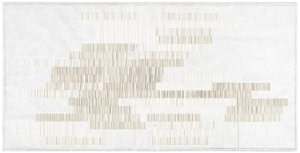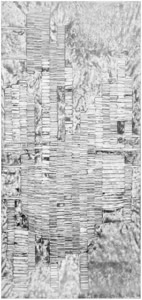
Untitled (Sup.Supri.Suprema, Familie), 2006, Xerox-copy / ink / pencil on paper, 48.3 x 36 cm
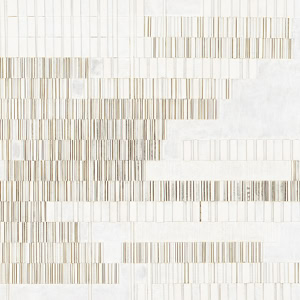
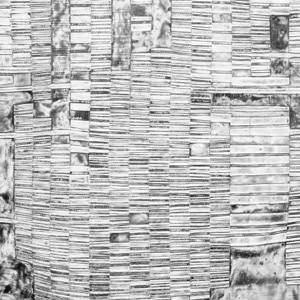
Detail Untitled (Sup.Supri.Suprema, Familie), 2006, Xerox-copy / ink / pencil on paper, 48.3 x 36 cm
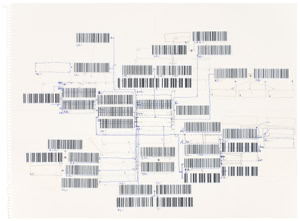
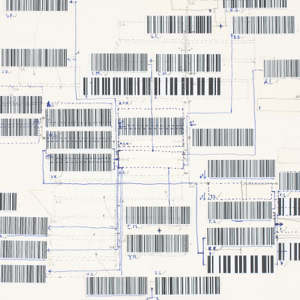
The work begins with a drawing: a radial mapping in which family names are systematically assigned to one another. This diagram functions as the project’s conceptual and structural blueprint, using lines and placeholders to define the spatial logic of the genealogy. Within this framework, first and last names are translated into the visual syntax of Code 128 barcodes—a standardized system that encodes characters through varying widths and intervals of vertical lines.
The barcodes are organized according to familial proximity: spouses appear in immediate sequence, while descendants radiate outward from the center. This arrangement generates a human-scale, three-dimensional ›Organigram.‹ The resulting paper relief—with its weighted, embossed bars—serves as the sculptural matrix for a latex mold.
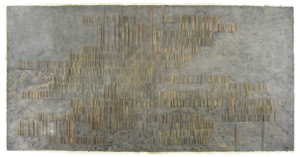
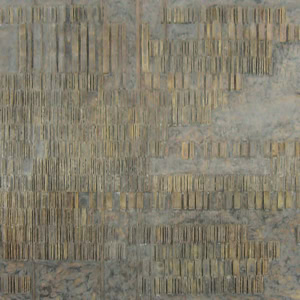
From this relief, a latex skin is cast, preserving the tactile imprint of the encoded data. The translucent membrane is subsequently backlit and photographed using a large-format camera. The process culminates in an enlarged gelatin silver print: a final act of translation that transforms structured information into a luminous, material record of kinship and connection.
Untitled (Sup.Supri.Suprema, Familie), 2006, Xerox-copy / ink / pencil on paper, 48.3 x 36 cm
Detail Untitled (Sup.Supri.Suprema, Familie), 2006, Xerox-copy / ink / pencil on paper, 48.3 x 36 cm
Untitled (Sup.Supri.Suprema, Familie), 2006, paper / Finnish woodpulp board / beeswax / gouache / linen, 197 x 100 cm
Detail Untitled (Sup.Supri.Suprema, Familie), 2006, paper / Finnish woodpulp board / beeswax / gouache / linen, 197 x 100 cm
Untitled (Sup.Supri.Suprema, Familie), 2006, pigment / latex, 195 x 98 cm
Detail Untitled (Sup.Supri.Suprema, Familie), 2006, pigment / latex, 195 x 98 cm
Untitled (Sup.Supri.Suprema, Familie), 2006, gelatin silver print mounted on dipond, 197 x 92 cm
Detail Untitled (Sup.Supri.Suprema, Familie), 2006, gelatin silver print mounted on dipond, 197 x 92 cm